Historic Baltimore housing stock presents distinct containment challenges during bedbug remediation. In brick rowhouses common across Fells Point, Canton, and Federal Hill, continuous party walls, unsealed subflooring,…
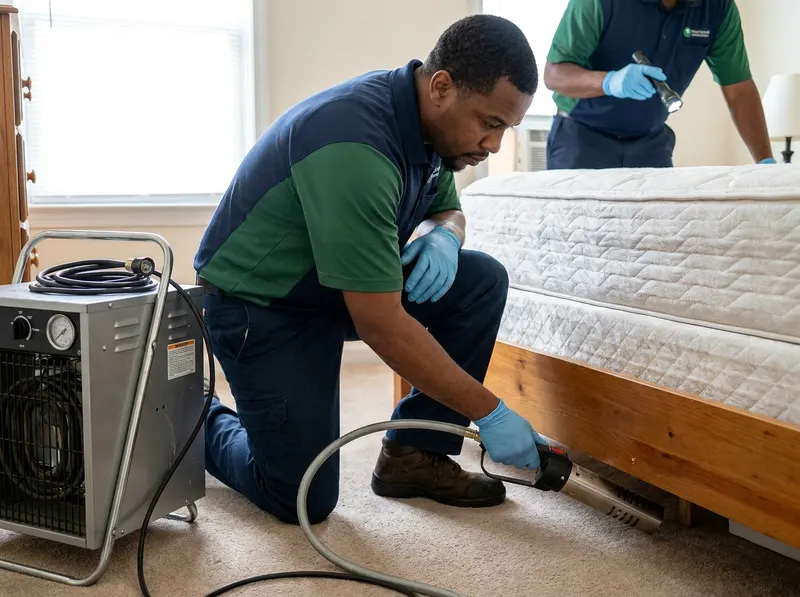
Historic Baltimore housing stock presents distinct containment challenges during bedbug remediation. In brick rowhouses common across Fells Point, Canton, and Federal Hill, continuous party walls, unsealed subflooring, and shared joist pockets allow bedbugs to migrate between properties when agitated by standard consumer aerosol sprays. Thermal convective heating eliminates migration risks by maintaining ambient structural temperatures of 122°F to 135°F using industrial forced-air exchangers. This continuous temperature penetrates mattress seams, hollow headboards, plaster cracks, and subfloors, coagulating insect cellular proteins without relying on volatile synthetic airborne chemicals that compromise indoor living spaces.
Selecting between full-structure thermal treatment and localized targeted chemical containment depends on property layout and infestation distribution. For multi-story detached homes in Roland Park or multi-room properties along Charles Village and Mount Vernon, whole-home thermal treatment is necessary to reach insects embedded within deep floor joists, heavy millwork, and radiator recesses in a single 8-hour operational window. The trade-off is higher electrical and mechanical staging requirements alongside the temporary removal of temperature-sensitive personal items like wax candles, pressurized canisters, and oil paintings. Conversely, for compact studio apartments or targeted bedroom infestations near Locust Point or Patterson Park, localized steam application paired with amorphous silica dust along baseboard channels offers a non-disruptive, lower-cost alternative, though it demands secondary follow-up inspections 14 days later to confirm newly hatched nymphs are intercepted.
Effective domestic containment requires sequential structural preparation. Step one involves clearing clutter from floors, stripping bed linens into sealed water-soluble laundry bags, and unhooking electronic wall plates to expose inner framing voids. Step two positions calibrated thermocouple temperature sensors in the deepest structural harborage points, verifying heat levels exceed the lethal 122°F threshold throughout the 4-hour soak duration. Step three applies non-repellent, long-lasting mineral dusts inside wall cavities behind outlet boxes to establish a preventative barrier that neutralizes any dormant pests before residents re-enter the treated space.
Every job gets a firm, written price after a free on-site visit.
Tell us about your bedbug thermal and targeted treatment job in Baltimore and we'll send a clear, written quote, usually the same day.
 Zandora Pest Relief