Subterranean termite soil barrier treatments address the unique architectural vulnerabilities of Baltimore properties, where historic brick foundations, stone rubble cellars, and party-wall framing create direct…
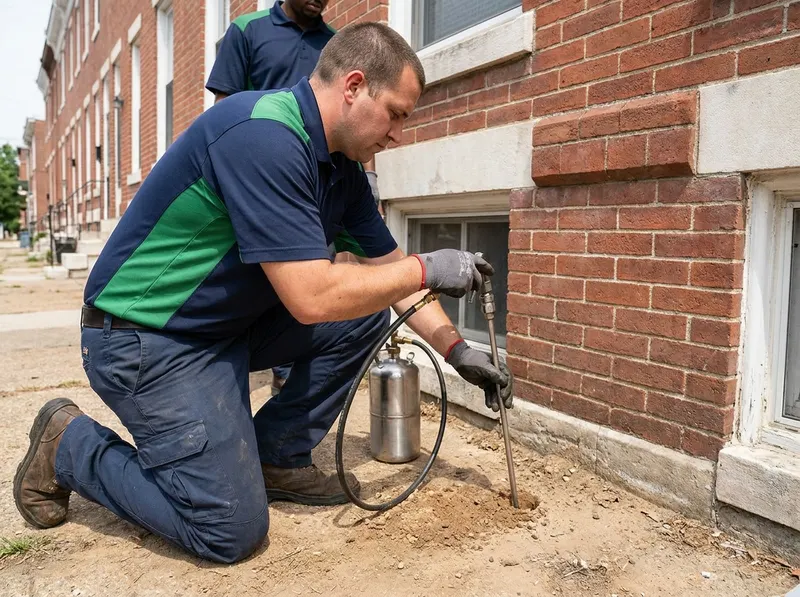
Subterranean termite soil barrier treatments address the unique architectural vulnerabilities of Baltimore properties, where historic brick foundations, stone rubble cellars, and party-wall framing create direct soil-to-wood contact points. In historic rowhouse neighborhoods like Federal Hill, Fells Point, and Mount Vernon, attached construction means soil access is often restricted to small front utility margins, narrow rear courtyards, or unexcavated cellar crawlspaces. Subterranean termites nest underground and construct protective earthen shelter tubes across porous stone footings to reach floor joists. Trenching exterior perimeter soil to a depth of 6 inches and treating backfilled soil at a baseline rate of 4 gallons per 10 linear feet per foot of depth establishes an unbroken defensive zone that stops termite worker traffic.
Properties located in Canton and Patterson Park regularly feature concrete patios, slab sidewalks, or brick paver walkways abutting structural masonry. A continuous chemical envelope cannot be achieved through trenching alone in these configurations. Specialized sub-slab injection involves drilling small 1/2-inch holes through masonry slabs spaced roughly 12 inches apart along the foundation perimeter, injecting the non-repellent liquid directly into the soil substrate below, and sealing drill holes with hydraulic cement. In detached residential layouts common to Roland Park and Charles Village, wider footprints require continuous external trenches along expansive crawlspace and basement perimeters, treating ground lines directly adjacent to historic fieldstone walls and perimeter plantings.
Selecting a liquid soil barrier over bait stations depends on immediate structural vulnerability. Liquid barriers are suited for active infestations discovered inside living areas or basements, providing an immediate treated zone that eliminates foraging workers within days through grooming transfer. Baiting systems suit situations where attached paved ground cannot be drilled or where long-term gradual colony suppression is preferred; however, bait ingestion takes several months to establish protection. Liquid barriers require a trade-off: homeowners must accept minor, temporary drilling holes in attached exterior hardscaping to ensure zero untreated gaps through which termites can bypass the barrier.
Every job gets a firm, written price after a free on-site visit.
Tell us about your subterranean termite soil barrier treatment job in Baltimore and we'll send a clear, written quote, usually the same day.
 Zandora Pest Relief